The Veiled Eye blog
Director's Treatment

Here, you will find my treatment on The Veiled Eye. It includes the synopsis, character profiles and general themes I wish to convey with the film.
Scripts and storyboards

every draft and version of the script can be found here, as well as the storyboard, drawn by Arthur Harris Moss
Production design

Some photos of the stellar production design by Arthur Moss can be found here, as well as photos of the costume designs by Rosie Duckworth
Link to Film and Additional material

The Veiled Eye was my writer directorial debut for my university film course, whose atmospheric qualities I am extremely proud of. I believe the story needs more clarity, and aim to create an extended cut of the film to achieve this.
on set and post production reflection
A reflection on my experience as director
As a writer director, it is my responsibility to ensure that everybody on set understands and is invested in my vision. I felt that I achieved this on the days of production, but at times was unfocused.
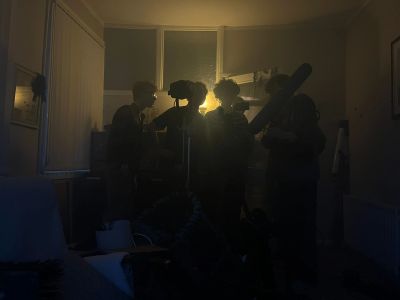
On the first day, I ran early rehearsals with my actors to ensure dialogue was well delivered and chemistry was developed between the two. I felt self conscious on how often I was checking in on and helping the crew with the set up for shots and lighting, but realised that, as director, my main responsibility was to ensure the actors were comfortable and well adjusted for the shoot, and to oversee the set up of shots, rather than to be hands on with every aspect at all times. One should strive to be hands on (or ready to be hands on) whenever they can, but the director- especially a writer director- is the architect of a shoot, and if the set has been set up how they want it, this is due to their ability to convey the vision to the crew, and the brunt of the hands on work is the responsibility of the other HOD's. A director collaborates with the other heads of department, they do not do their job for them.
An oversight on the first day was my decision to add dialogue to the 4th scene of the film, but failing to tell the sound designer of this change, causing confusion. Keeping on top of knowledge on set is essential, if someone is out of the loop, they may not even know so yet. It is my job to ensure everyone knows what is happening on set.
On the second day of the shoot, I felt I was out of focus due to two reasons. Firstly, a friend from my home was helping as a camera assistant on the shoot, and I found myself chatting to them when I should have been on top of the scene's set up. The second reason caused the entire set's morale to be lowered. A crew member was being particularly snarky and destructive on set, leading to him being nearly kicked off set and shouted at for his attitude. The way he acted for the rest of the day, as well as the main incident of his rudeness, caused morale to lower on set. Things got done, and overall, I believe the footage from day two to be superior to day one, but the morale was notably low.
On the third and final day, I felt I understood my role as the director the most, overseeing set contributions and being balanced in my attention. I took particular care in the safety of actors, as one of the scenes was outside on the cold and dark beach, so I took extra care to make sure my actors were not freezing; taking them indoors with hot drinks in between shots to discuss character.
In the editing room, I trusted the editor to achieve my vision, and focused primarily on the post sound with my sound designer, as I am very particular with my sound design. This is not to say that I did not trust my sound designer, quite the contrary, but it is to say that I believe my ear for sound was what informed the atmosphere and vision for the narrative of the film the most when writing it. I emphasised the importance of the ambience, and wanted to ensure that the film had an emphasis on bass and reverb, creating a "deep sea" ambient soundscape. Visually, I took care to ensure the colour grader created a calming and soft lighted colour palette which reflected the characters psychology.